In the wake of Earth Hour this Saturday 29th of March I thought a
post on the impact climate change is having on our beautiful national icon the
Great Barrier Reef, was in order. This years tag-line for Earth Hour in
Australia is "Lights out for the Reef" and it aims to raise awareness
of how the rising temperatures of climate change are killing our reef,
and within our life times we may see the end of it as we know it - if we don't
take action!
But how exactly does a
little temperature rise hurt our corals?
Coral reefs are a significant resource and are highly sensitive to the
surrounding environment. They are very well adapted to certain temperatures,
salinities, clarities and sea levels. Temperature, in particular, has dramatic
effects on corals. In the last 4 decades sea surface temperatures over much of
the tropics have increased between 0.4°C and 1°C. This temperature increase,
while only marginal, is crucially significant for coral health and security.
With this rise in sea surface temperatures there has been an increase in coral
bleaching and the mortality rates of corals, altering the coral community
structure and ecosystem function.
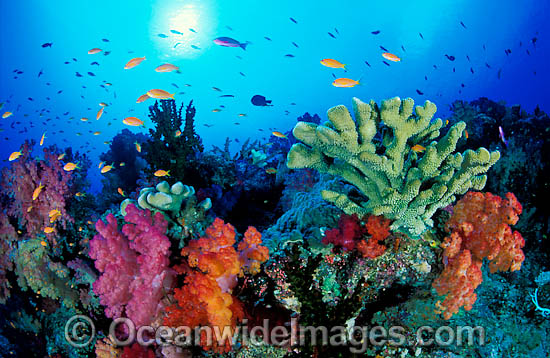
Modern corals, Scleratinia, appeared in the geological record in the
mid-Triassic, replacing the preceding tabulate and rugose corals that died out
in the Permian mass extinction. Populations of Scleratina corals grow as either
colonial or soliarty depending on environmental conditions. Colonial corals are
found in clear, shallow, tropical waters and are reef builders, whereas
solitary corals can live in deep, temperate waters and do not build
reefs.
 |
Reef building corals, known as Hermatypic corals, are the corals
most susceptible to temperature changes. The majority of these are
zooxanthellate, which means that they have a symbiotic relationship with
algae. A symbiotic relationship is one where both parties involved win, so
the algae lives in the coral much like a parasite but unlike a parasite
it doesn't hurt the coral it helps it and the coral gives the algae a
habitat. These symbionts (the algae) are very important for coral health.
The oxygen the zooxanthellae produce through photosynthesis, as well as the
organic carbon they produce is absorbed by the coral and dramatically increases
calcification rates (that is: the growth rates of the coral). These benefits
are crucial to coral survival and therefore corals can only exist in the photic
zone (the zone with light in the ocean) to ensure photosynthetic efficiency of
the zooxanthellae.
Hermatypic corals need a minimum water temperature of 18°C but flourish
with temperatures between 25°C and 29°C. However, it is important to note that
there is vast variation between optimum temperatures for different species of
corals and this is just a generalisation. Corals have adaptations to the
environment that they live in, depending on the latitude and the natural
temperature ranges of that environment. Variations from these natural
temperatures can be fatal, more so than being in the general optimised
temperature range. For example, the maximum calcification rate for Plesiastrea
versipora in Port Phillip Bay, Victoria, Australia, occurs at approximately
18°C where the mean ocean temperatures fluctuate between 10 – 20°C. While
maximum calcification rates occur at 26°C for Pocillopora damicornis at
Kaneohe Bay, Hawaii, where ocean temperatures range from 23°C to 27°C.
The rise in temperature from the normal for a certain coral affects
growth rates because of the symbiotic relationship between the coral and
zooxanthellae. A rise of 2°C from the mean maximum ocean temperature has been
documented to cause a decrease in the capacity of the zooxanthellae to
photosynthesise. This may be due to a loss of the zooxanthellae due to
expulsion from the coral host, or a loss in their photosynthetic ability. In
order for photosynthesis to work properly enzymes help to make the right
reactions happen. As enzymes are temperature dependant, they denature with
elevated temperature and then they are unable to catalyse reactions as
effectively, hindering the light independent reactions (or the Calvin-Benson
Cycle) and thus, photosynthesis. Therefore, there is a decrease in the
availability of the algal derived photosynthate that drives calcification
(growth rates), leading to a lower calcification rate that is likely to be
defeated by dissolution (dissolving) and bioerosion. This is known as coral
bleaching and a slight rise from the optimum temperature range causes an
increased vulnerability of coral deterioration, and ultimately coral mortality.
Water temperatures which are below the tolerance threshold also effect
coral growth in the same manner as heat stress, causing the loss of
photosynthetic efficiency from the zooxanthellae.
The general lower limit for tropical corals reefs is 18°C, however it has been
noted that some corals can live under much colder conditions, such as a species
of Porites that survived at 11.5°C for a month in the Arabian
Gulf.
Temperature is such an important element to coral growth
and ultimately, ecosystem foundation. With the progression of climate change,
extremes are going to become more common, both warm and cool. It is evident
that this will cause stress to corals everywhere through their fragile
symbiotic relationship with zooxanthellae, leading to an alarming outlook for
corals!
So what can
you do to help our corals?
There's many things you and I can do to take action on climate change.
The simple act of turning out the lights for one hour on Saturday 29th shows
you just how easy it is, we all leave lights on we don't actually need, start
by only putting on the essential lights and turning off lights when you leave a
room. You can take the option of public transport to work or school, to save
you money on petrol prices and spend time reading or responding to emails
instead of concentrating on the road when you drive as well as reducing the
amount of greenhouse gases being emitted to the atmosphere. Better still, you
could ride to work and get fit without having to spend time at the gym. Lastly,
sign the pledge at http://earthhour.org.au to say “I
believe Australia can and must help solve climate change and I want to be part
of it.”
Its not only the reef that climate change
will effect, so lets work together to act on climate change, for the sake of
our children and grandchildren.
And also Nemo... we'll have a hard time finding him if his habitat is
gone forever!
Thanks for reading,
Rach
 |
|
|
Further Reading:
Cantin, N.E., Cohen, A.L., Karnauskas, K.B., Tarrant, A.M., McCorkle,
D.C. 2010, ‘Ocean Warming Slows Coral Growth in the Central Red Sea’, Science,
vol. 329(5989), pp. 322-325.
Edmunds, P. J. 2005, ‘The effect of sub-lethal increases in temperature
on the growth and population trajectories of three scleractinian corals on the
southern Great Barrier Reef’, Oecologia, 146(3), pp. 350-364.
Jones, R. J., Hoegh‐Guldberg, O., Larkum, A.
W. D., Schreiber, U. 1998, ‘Temperature‐induced
bleaching of corals begins with impairment of the CO2 fixation mechanism in
zooxanthellae’, Plant, Cell & Environment, 21(12), pp. 1219-1230.
Marshall, A.T., Clode, P. 2004, ‘Calcification rate and the effect of
temperature in a zooxanthellate and an azooxanthellate scleractinian reef
coral.’, Coral reefs, vol. 23(2), pp. 218-224.
Saxby, T., Dennison, W. C., Hoegh-Guldberg, O. 2003, ‘Photosynthetic
responses of the coral Montipora digitata to cold temperature stress’, Marine
Ecology Progress Series, 248, pp. 85-97.

No comments:
Post a Comment