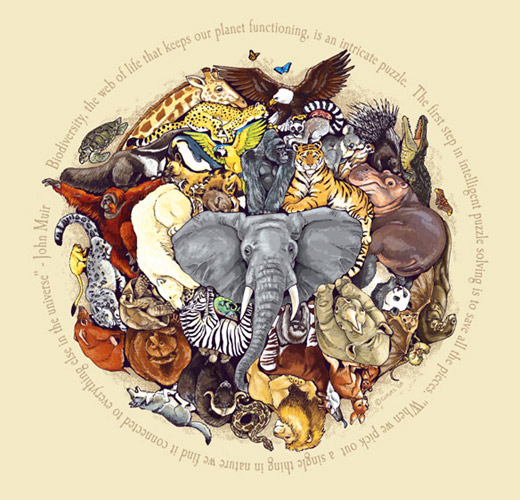
Biodiversity is the short hand for biological
diversity, and includes all life on Earth, from you and me, to cute and cuddly
animals, trees and flowers, to tiny bacterium and even our genes.
 |
| biodiversity puzzle.jpg |
Biodiversity
is perhaps one of the most significant, and under appreciated phenomenon’s on
Earth. It provides us with significant services such as:
- · Food: A lot of our food comes from biodiversity, and its not just plants as you may think (although about 150 species of plant are commonly used for food), its also domesticated wildlife that provide much of our animal protein, fish and other aquatic organisms (farmed or wild), yeast (used in the very important act of brewing beer) and other bacteria used in the processing of milk/chocolate etc.
- · Aesthetics: No one is a stranger to this ecosystem service of biodiversity! Everyone loves going to a beautiful beach or out to the bush and enjoying the view and wildlife. Did you know that ecotourism earns the economy about $9.6 billion a year?!
- · Genes: While they’re not the cute and cuddly part of biodiversity, genes are a very important part, perhaps the most important! They are used in most forms of cropping, and have been for a very long time (much before the introduction of genetically modified organisms!). Useful genes (or alleles) are commonly brought together in one individual for selective breeding, producing disease resistant crops (such as rice). It is also important to note that proper gene flow is the essence of continuance in biodiversity. If a population of individuals is separated from the rest of their population (by habitat fragmentation for example) the gene flow is restricted, leading to homozygousity (resulting from inbreeding). This is means that they don’t have the full diversity of genes that a heterozygous (breeding between unrelated individuals) individual would have. A heterozygous individual is fit (biologically speaking) leading to a better immunity (because greater variety in genes means less chance of all of them being susceptible to a certain virus), a greater ability to cope with different environmental conditions and more reproductive success. Alternatively, a homozygous individual is much more likely to have less ability to cope with variances in temperatures, be less successful in reproduction leading to population decline and be more susceptible to diseases, thus local extinctions are much more likely.
- · Clean air: Air quality is a rather obvious (but very important) service that biodiversity provides. Through the process of photosynthesis plants take in carbon dioxide (our most common greenhouse gas) and discharges oxygen (for us to breath… yay!).
- · Water shed: Have you ever noticed how most of our water catchments for dams are forested? Well this is because forests play a big role in keeping our water of a high quality. Clearing these catchments can lead to a rise in salinity levels. This is because the trees are intercepting and using some of the rain water and then some infiltrates through to recharge the groundwater, but without the trees the groundwater recharge is in surplus, while automatically one would think that this is good – more stored water for our water tight country, right? Well because that groundwater is in contact with rocks, regolith, soils and other things it is usually quite saline. Without the trees to tap into this water is rises to the surface, bringing with it is salt, leading to land salinization (As seen in many areas cleared for cropping, but now due to the salinity issue it can not grow crops anymore).
- · Pharmaceuticals: Future advances in pharmaceuticals and new cures for disease will depend heavily of the genetic diversity of natural sources, probably from such organisms never considered to be important. Currently, scientists are researching the anti-cancer properties of sea sponges.
All of this means that preserving our biodiversity now
is important for future endeavors that may include pharmaceuticals, food
security, air quality or other advances in technology that are not even known
yet! Unfortunately though, biodiversity
is in decline, and that means all these really important ecosystem services are
too. Naturally, all living things on Earth have a common trajectory of
extinction, however, the rate of extinction today is about 1000 times the
natural rate.
The biggest threat to biodiversity globally comes about
through habitat fragmentation and habitat loss through deforestation for
agriculture, cropping, palm oil plantations or urbanization. Coming in at a
close second for Australia is introduced species, followed by changes in the
fire regimes. How can we combat these issues? In the next few blog posts I will
look at these problems in further detail as well as their solutions (and the
validity of those) … so stay tuned!
Thanks for reading!
References:
Evans, et al. 2011. The
spatial distribution of threats to species in Australia. Bioscience 61:281-289.

No comments:
Post a Comment