With all these explosions in the early times of the universe it was
a whole heap of dust and particles that eventually formed our solar system through the Nebular Hypothesis. The theory is that a
rotating disk of dust formed and the concentrated centre became our sun. As the
dust and particles started to collide when rotating around the sun they accreted into planetesimals. The
heavier elements were brought to the centre by the force of gravity and
accreted to form the first four planets, Mercury, Venus, Mars and Earth. These
planets are the terrestrial planets and are characterized by a metallic
core surrounded by a rocky shell. An asteroid belt separates the terrestrial planets and the juvian planets. The juvian planets were formed by the lighter elements and these are, Jupiter,
Saturn, Uranus and Neptune. They are made up of volatile gasses, not unlike our
sun, however the internal pressure of these planets is too low for
nucleosynthesis to occur.
 |
| The Nebular Hypothesis 0_Our_solar_system.jpg |
Now let’s take a focus on our planet,
Earth, which was formed as described above approximately 4.6 billion years ago. Early earth was bombarded with many asteroids which provided us with the
iron-nickel rich core we have today. But if they hit the surface of this rocky
planet, how did the iron nickel end up in the core? At the time when these
asteroids hit the Earth was, essentially, one hot mess! This was called Hadean
Earth. At this time the rock
was still molten and the stratification of the Earth was able to occur. The heaviest
elements (like iron) simply sank to the Earth's centre. These iron-rich minerals in the core
explain Earth’s magnetic field, which has reversals every so often, which is most likely due to the
currents of the iron rich liquid changing. The magnetic field is responsible
for deflecting most of the solar wind from around the Earth, and therefore
allows life on Earth!
Early Earth had a faint young sun and
nowhere near as much solar radiation was put out as there is today. The Earth would have frozen over if it weren't for the very rich CO2 atmosphere that it had causing a greenhouse and the
lack of vegetation to uptake CO2. Once Earth’s crust solidified, around 4.4
billion years ago, it was surprisingly similar to what the Earth looks like
today (geologically so there were oceans and continents, plants and animals had not arrived yet - thats for a later blog!). However there was a lack of oxygen and a CO2 rich atmosphere, but we
believe that the ocean mass was approximately the same. How do we know this? Zircons!
If dogs are a mans best friend, Zircons must be a Geologists best friend
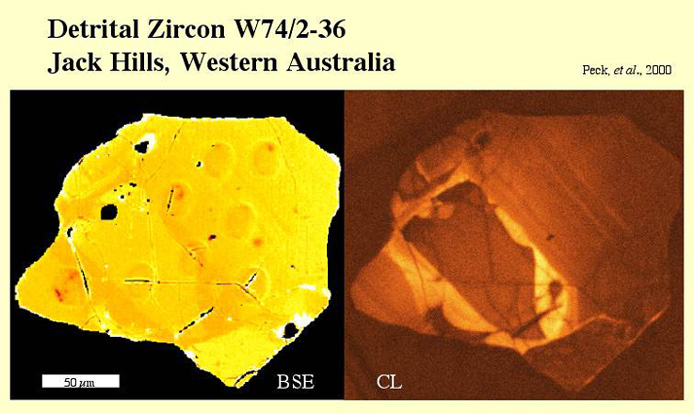
because they will always be there for you! From jack hills in WA zircon
crystals have been found and dated back to 4.38 billion years ago. Zircon has uranium in its lattice which decays to lead at a precise age and it is because of this long time span that scientists are able to date rocks with Zircon present.
 |
| 19.jpg |
So there you have it, the universe was created around 13.7 billion years ago, and Earth about 4.6 billion years ago... feeling youthful?
Thanks for reading,
Rach

No comments:
Post a Comment