 |
| astro_bk_still1.jpg |
 |
| 10_04.jpg |
The origin of Saturn’s rings
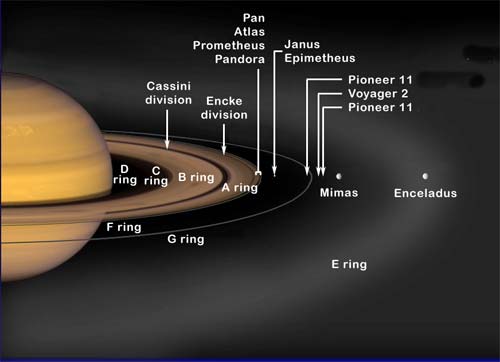
The origin of Saturn’s rings has long been a
captivating mystery of the Solar System. First noted by Galileo in the early 17th
century were ‘handles’ appearing around Saturn. Not long after, they were
correctly named rings by Christiaan Huygens in 1655 and then Cassini noted
their composite structure in 1675. Today, the insight into Saturn’s rings has
continued to progress as technology permits, accelerating significantly with
the dawn of spacecraft, leading to an ensemble of theories into the rings
origins. Below the three main theories, and the validity of those, will be
discussed.
Just a note before I begin, the ‘Roche Zone’
is the zone in which the gravity forces (also called tidal forces) from the
planet are much too large that particles can not accrete to become anything
larger, say a moon, and if a moon or comet where to pass the Roche Limit then
it would be ripped apart (depending on its composition and proximity to the
planet). Also: when I started researching into this I wasn’t aware that
satellite’s aren’t just the man made things orbiting planets, they can be
natural too and are pretty much interchangeable with moon – just in case you
didn’t know that either! Alright – lets go!
Theory
1: Saturn’s rings are ancient remnants of the planets
formation.
Until the spacecraft ‘Voyager 1’ arrived at
Saturn in 1980, it was believed that the rings where composed of detritus left
behind after the planets formation from a sub-nebula disk, approximately 4.5
billion years ago (What is a nebula disk? Check out blog post from March 2014 -
‘Day Dot’). Due to being within the planets Roche zone, the strong tidal forces
on them prevented accretion into anything larger than the order of a few meters
in diameter. However, this hypothesis is deemed improbable due to the fact that
if this were true, it is assumed that the classical satellites of Saturn would
have a similar composition to that of the rings, which is not apparent.
Secondly, the rings are void of gases, which is not coherent with the
composition of a sub-nebular disk and lastly, the relatively rapid evolutionary
rate of rings would mean they would have disintegrated if their origin was at
the time of the planets formation.
Theory
2: Saturn’s rings are results of catastrophic
collisions.
The second theory was proposed with new information
from the Voyager mission. This view suggested there was a catastrophic
collision (or collisions) with pre-existing icy moons, either between
themselves or with comets. The collisions are assumed to have taken place
within the planets Roche zone, so like sized particles could not accrete, the
debris then created rings of particles that were captured in the orbit around
Saturn. Small moons were also discovered and these were thought to be larger
collisional shards left behind from the impact. However, this theory has been
doubted by some because of the difference in a moons typical composition of a
silicate rich core and that of the almost pure ice rings. This may be explained
by small impacts that do not destroy the entire moon, but just its outer
layers, much like the formation of Earth’s moon. If the moon was already
differentiated into an icy mantle and silicate rich core then the collisions
could send the icy particles into space, eventually forming into rings, and the
dense core left behind may then have been pulled into Saturn by tidal forces.
Theory
3: Saturn’s rings are results of comets or satellites
drifting within the planets Roche limit
The mass of Saturn’s rings is comparable to
that of the mass of Saturn’s satellite Mimas, thus this has led to the
suggestion that another object of similar size drifted into the planets Roche
zone and was destroyed. However, tidal forces alone would not be able to
totally destroy a Mimas sized object (200-300km radius) down to particles of
approximately a centimetre to a meter in diameter because a body that size
would also have its own Roche limit, so another collisional event would have also
been necessary. It has been suggested that this ‘object’ may have been a comet
caught by Saturn’s gravity in a close passage by the planet and Saturn’s tidal
forces then ripped it apart. Although, an issue presents in this theory as the
current rate of comet fly-bys is much too low for a close passage to be likely
in the last billion years. Furthermore, the discrepancy between the composition
of the rings and the composition of a comet, led to this scenario showing
further ambiguities.
A recent suggestion by Canup (2010) appears
to resolve the composition issue; instead of a comet, a satellite drifted
within the planets Roche zone. The formation of large satellites is associated
with the generation of a large amount of heat in the interior, which is likely
to lead to ice melting and thus, differentiation. As the ice melts, the rock
initially contained within the ice is released and due to its higher density it
sinks to the core of the satellite resulting in a satellite with a mantle of
ice and rock rich core. It is suggested that through the concept of planetary
migration a differentiated satellite approached the Roche limit, passing it and
thus allowing the tidal forces to strip the outer, icy and less dense layers
from the more stable, silicate rich core. As tidal forces are not strong enough
to destroy the silicate rich core it will continue towards the planet until it
eventually falls into it.
 |
| Canup, 2010 |
The
age of Saturn’s rings
The debate about the age of Saturn’s rings is
perhaps even more complex and multifaceted than that of their origin. Some
argue that due to the fact that the rings evolution (from meteoroid bombardment
causing darkening and viscous spreading) is at a relatively rapid rate (when we
say rapid in astronomy we’re talking hundreds of millions of years!), they must
be young perhaps forming within the last billion years, while others suggest
that the rings are less viscous than previously thought and would thus have a
longer evolutionary time scale. On the other hand, if the theory of comet
interference were correct, some suggest that the current rate of passing comets
is much too low for comet interference to have been apparent in the last
billion years, thus suggesting an older formation. A more recent theory of
‘cosmic recycling’ has also been suggested, where the rings are constantly refreshed
therefore appearing young however, are primordial. Although, even recycling of
the material does not explain their brightness, as meteoroid darkening would
still be apparent, so perhaps the total mass of the rings has been
underestimated and more pollution has occurred than previously thought. Further
research into this issue is needed to resolve the true age of Saturn’s rings.
Overall, the theories of Saturn’s rings
origins have progressed astoundingly from the days of the first ever fly by
mission of the Voyager 1. Suggestions of the origin of the rings from planet
formation have mostly been dismissed due to the rings composition and evolution
timescales. Theories of collisional or comet origin seem improbable on
evolutionary timescales with the current rate of comet bombardment and also due
to their compositional discrepancy, therefore differentiated satellites
drifting into the Roche zone has been suggested as a plausible theory. Perhaps,
they are older than previous estimates, with cosmic recycling and/or hidden
mass; placing the comet bombardment theories once more within reason. To
reliably solve this debate further research is essential. Fortunately, with the
high quality of spatial and spectral data currently being received from Cassini
(the spacecraft orbiting Saturn since 2004), further insight into the mass,
composition, structure and particle size of the rings may just bring the
resolution to the great mystery of the origin of Saturn’s rings.
Thanks for reading!
Want to learn more about the Cassini mission?
Here is a cool site that has a time line of all Cassini has discovered,
interestingly this spacecraft was not expected to last this long but is now
projected to keep surveying Saturn until 2017 when it is planned to enter
Saturn’s atmosphere! http://saturn.jpl.nasa.gov/interactive/missiontimeline/
References
Canup, R. M. (2010). ‘Origin of
Saturn's rings and inner moons by mass removal from a lost Titan-sized
satellite’, Nature, 468(7326), 943-926.
Charnoz, S., Morbidelli, A.,
Dones, L., Salmon, J. (2009b). ‘Did Saturn's rings form during the Late Heavy
Bombardment?’, Icarus, 199(2), 413-428.
Connerney, J. (2013). ‘Solar
system: Saturn's ring rain’, Nature, 496(7444), 178-179.
Crida, A., Charnoz, S. (2010). ‘Solar
system: Recipe for making Saturn's rings’, Nature, 468(7326),
903-905.
Cuzzi, J. N., Burns, J. A., Charnoz, S., Clark,
R. N., Colwell, J. E., Dones, L., Esposito, L. W., Filacchione, G., French, R. G., Hedman, M. M., Kempf, S., Marouf,
E. A., Murray, C. D., Nicholson, P. D., Porco, C. C., Schmidt, J., Showalter,
M. R., Spilker, L. J., Spitale, J. N., Srama, R., Sremcevic, M., Tiscareno, M.
S., Weiss, J. (2010). ‘An
evolving view of Saturn’s dynamic rings’, Science, 327(5972),
1470-1475.
Porco, C. C., Thomas, P. C.,
Weiss, J. W., Richardson, D. C. (2007). ‘Saturn's small inner satellites: Clues
to their origins’, science, 318(5856), 1602-1607.
Salmon, J., Charnoz, S., Crida,
A., Brahic, A. (2010). ‘Long-term and large-scale viscous evolution of dense
planetary rings’, Icarus, 209(2), 771-785.
